Latest news

Why Traveler Reviews Matter: Insights from 900+ Destinations
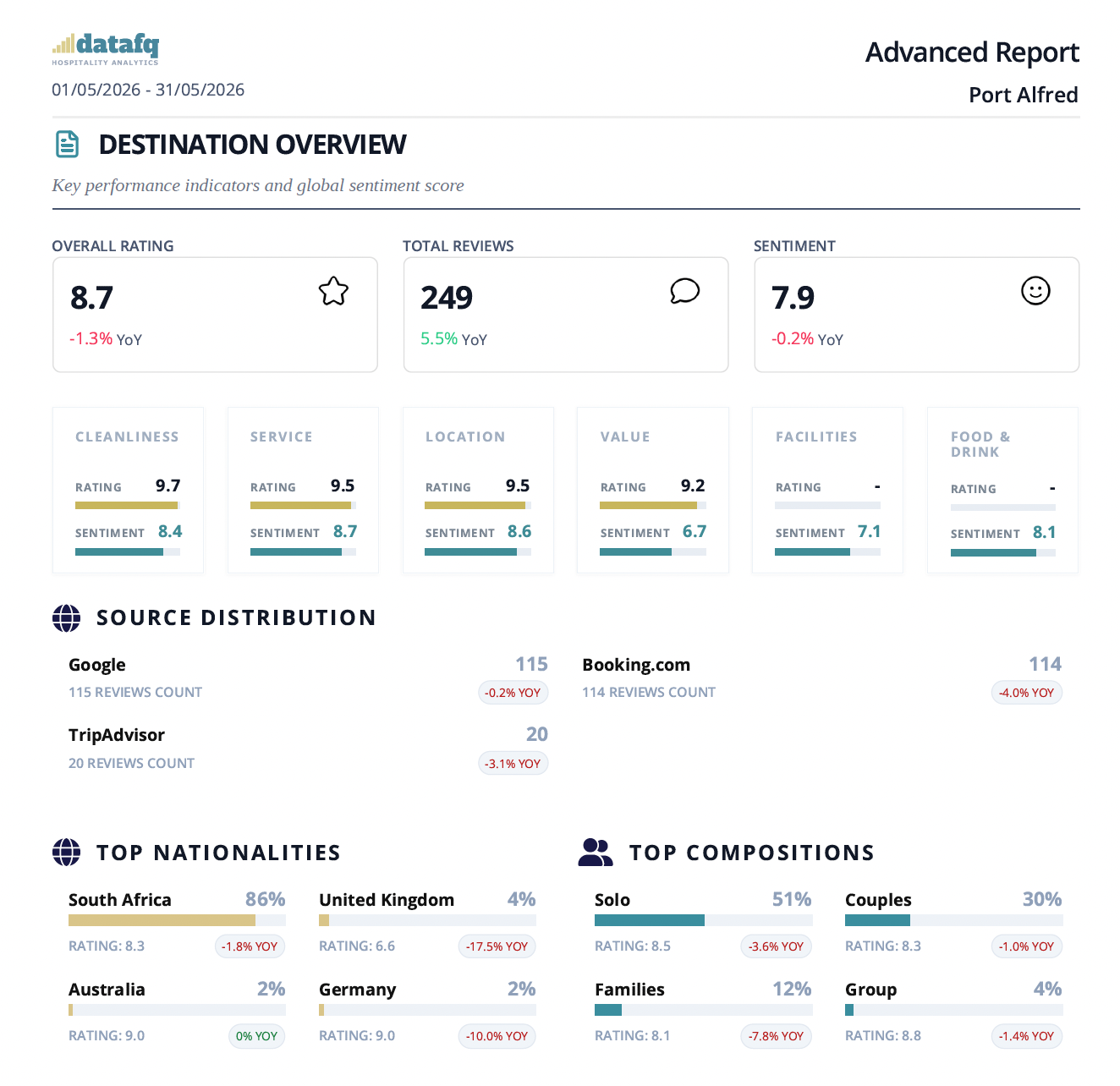
DATAFQ delivers monthly Destination Intelligence reports to more than 900 cities and destinations across Europe and South Africa. The reports transform thousands of traveler reviews from over 50 platforms—including Google, TripAdvisor, Booking.com, Expedia, and regional review sites—into actionable insights for destination marketers and tourism leaders. Reviews matter because they represent the authentic voice of visitors, influencing travel decisions, destination reputation, and future demand. Research consistently shows that travelers trust online reviews as much as personal recommendations, making review data one of the most valuable sources for understanding visitor satisfaction, identifying improvement opportunities, benchmarking against competitors, and strengthening destination performance.
Asset Value Intelligence (AVI): Turning Data into Hotel Performance
AVI (Asset Value Intelligence) combines guest experience data, online reputation, market benchmarking, and operational performance into a single intelligence framework. By analyzing guest feedback, competitive positioning, and key performance indicators, AVI helps hotel owners, operators, investors, and asset managers identify opportunities to improve performance, strengthen market position, and enhance long-term asset value. Through quarterly reviews and expert guidance from Colliers and DATAFQ, organizations gain actionable insights that support better strategic and operational decisions.

Combining Reputation Intelligence and Content Management
DATAFQ and Event Connectors help destinations make smarter decisions through the combination of Destination Intelligence and Destination Content Management. While Event Connectors centralizes and distributes event, venue, route, and destination information across digital channels, DATAFQ transforms millions of traveler reviews into actionable insights on visitor satisfaction, reputation, and competitive performance. Together, we provide destination organizations with a more complete view of both what visitors experience and how destinations perform, helping tourism leaders improve visitor experiences, strengthen destination visibility, and make more informed strategic decisions.
In samenwerking met Event Connectors laten we zien dat de toekomst van destinatiemarketing niet alleen draait om het promoten van een bestemming, maar vooral om het begrijpen van wat bezoekers écht ervaren. Event Connectors zorgt ervoor dat bestemmingen beschikken over actuele, gestructureerde data over evenementen, locaties en routes, terwijl DATAFQ deze verrijkt met reputatie- en reviewdata uit tientallen bronnen. Samen helpen we DMO’s om niet alleen zichtbaar te zijn voor bezoekers én AI, maar ook continu te sturen op een betere bezoekerservaring, een sterkere reputatie en duurzame groei.

Europe Isn't Just a Destination. It's the World's Tourism Powerhouse
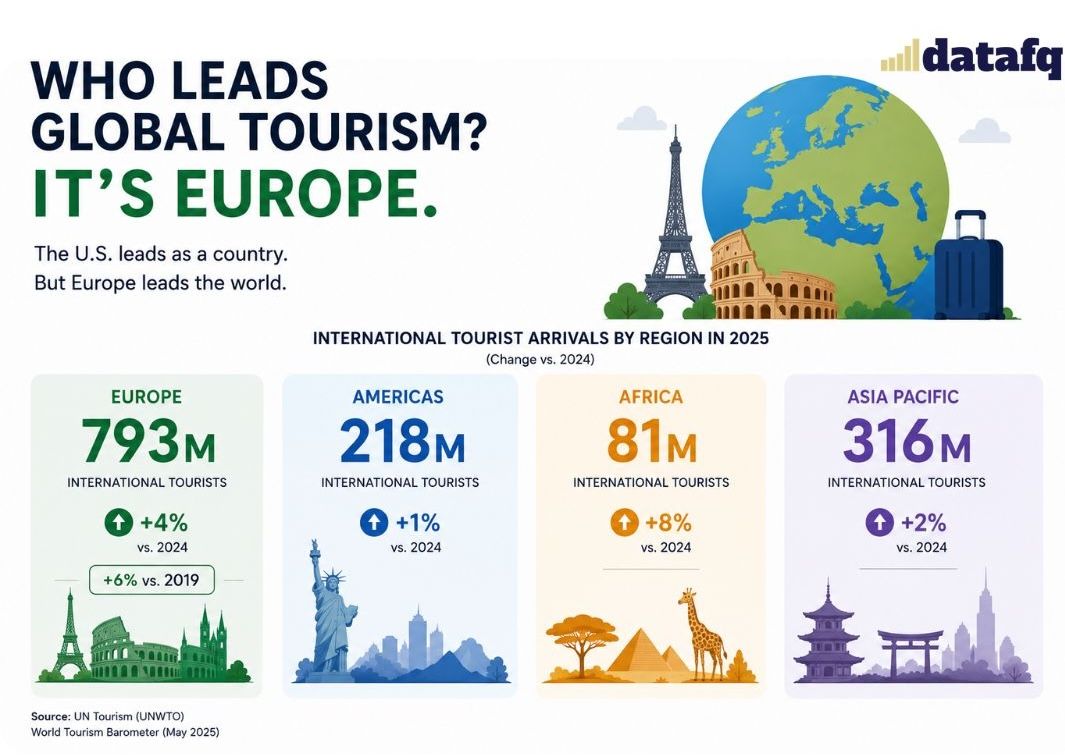
The U.S. may lead as a single country by tourism revenue, but Europe remains the true global tourism powerhouse.
In 2025, Europe welcomed an estimated 793 million international tourists, making it the world’s largest tourism region. That’s 4% growth compared to 2024 and 6% above pre-pandemic 2019 levels. By comparison, the Americas recorded approximately 218 million international arrivals, growing by just 1%.
This highlights an important distinction that is often overlooked. While individual destinations such as the United States, France, Spain, Italy, and the United Kingdom compete for visitors, Europe as a whole continues to dominate global travel demand. Its unique combination of culture, history, gastronomy, accessibility, diverse landscapes, and dense network of destinations creates an unmatched tourism ecosystem.
For destination marketers, tourism boards, hospitality businesses, and policymakers, this presents a significant opportunity. The challenge is no longer attracting visitors to Europe, but understanding changing traveler expectations, managing reputation, and delivering experiences that encourage visitors to stay longer, spend more, and return.
The data is clear: Europe is not just participating in global tourism growth. It is leading it.
#Tourism #Europe #TravelIndustry #DestinationMarketing #Hospitality #DataAnalytics #TourismEconomy #TravelTrends #CityMarketing #HospitalityIndustry #TourismData #DataDriven #TravelInsights
DATAFQ | UNWTO | European Travel Commission | NBTC

REPUTATION IS NO LONGER A MARKETING METRIC. IT'S AN ECONOMIC ASSET.
Online reputation is no longer just about marketing. It directly impacts demand, revenue, pricing power, and long-term competitiveness.
Research consistently shows that businesses with stronger review performance attract more customers, achieve higher occupancy, increase revenue, and gain greater pricing flexibility. At the same time, poor guest sentiment—particularly around cleanliness, service, and value—can quickly reduce trust and booking conversion.
The reason is simple: travelers trust other travelers more than they trust advertising.
As a result, reputation influences not only revenue, but also customer acquisition costs, direct bookings, OTA visibility, and overall business performance.
For hotels, restaurants, attractions, and destinations, reputation is no longer a reflection of performance.
It has become a driver of performance.
#ReputationEconomy #HospitalityData #DestinationAnalytics #TourismInsights #TravelAnalytics #DataDrivenTourism #GuestExperience #Hospitality

Why Reputation Data Should Be the New Foundation of City Marketing
City marketing is still too often treated as campaigns, slogans and polished videos of beautiful streets where the sun always shines and nobody ever complains about parking.
Nice, but incomplete.
The real reputation of a city is not built in a marketing deck. It is built in the actual experience of visitors: the hotel check-in, the restaurant service, the coffee, the taxi, the museum queue, the cleanliness of the street and the moment someone wonders why a simple sandwich suddenly needs venture capital.
All of that ends up online.
Google, Tripadvisor, Booking, Yelp, OpenTable and social media have become the unofficial reputation dashboard of every city. Together, these reviews tell a much more honest story than any campaign ever could.
And visitors do not separate that story into departments. They do not think: “The service was terrible, but luckily the city brand architecture was excellent.” A city is experienced as one journey. If hospitality fails, the city feels less attractive. Simple, slightly painful, very measurable.
That is why city marketers should treat reputation data as strategic intelligence, not as digital noise.
Reviews show what visitors really value, where friction appears and which parts of the city create trust, joy or irritation. They reveal patterns around service quality, safety, value for money, accessibility and atmosphere. In other words: the stuff people actually remember after the logo has faded.
Reputation data also moves faster than traditional research. By the time a visitor survey is finished, printed, discussed and politely ignored in a steering committee, thousands of new reviews may already have shown what is going wrong or right.
For city marketers, that is gold. Not shiny campaign gold. Useful gold.
It helps answer the questions that matter: Which neighbourhoods are winning? Which businesses strengthen the destination? Where are visitors disappointed? What complaints keep coming back? And where is the city promising one thing while delivering another?
Because if a city positions itself as welcoming, premium and vibrant, but reviews keep mentioning rude service, dirty streets and confusing information, then the problem is not branding. It is reality wearing a bad outfit.
Entrepreneurs’ associations have a major role to play here. A city’s reputation is not only built by municipalities or tourism boards. It is built every day by hotels, restaurants, shops, cafés, venues and local service providers.
One great business can lift a street. Ten mediocre experiences can drag down an entire area. Reputation is contagious. Sadly, unlike enthusiasm at most networking breakfasts, it actually spreads.
Entrepreneurs’ associations can turn reputation into a shared economic asset. They can monitor review trends, help members respond professionally, identify recurring issues and bring useful insights to city marketers and local government.
If multiple businesses receive complaints about accessibility, safety, pricing or service, that is not just an individual problem. It is a collective signal. And smart cities act on signals before they become headlines.
The commercial value is obvious. Better reputation means more trust. More trust means more bookings, more visits, higher spending, stronger recommendations and a better chance that visitors return instead of filing the city under “nice, but never again.”
Reputation data is not a side issue. It is economic infrastructure. Visitor numbers tell you who came. Reputation data tells you whether they would come back.
City marketing should therefore start less with broadcasting and more with listening. Because a city with weak reviews usually does not need a new slogan. It needs to fix the experience. And maybe the sandwich pricing.

Oxfordshire County Council knows what visitors say in surveys. But what do they say when nobody is asking
Experience Oxfordshire recently published an interesting study into how visitors and non-visitors perceive the destination. There is plenty of good news: 83% of visitors are likely to return, while safety, hospitality, attractions, culture and cleanliness all perform strongly.
But one statistic caught my attention: 15% of people who have never visited Oxfordshire already have a negative perception of it. They haven’t been there, yet the destination already has a reputation in their minds.
Welcome to destination management in 2026.
Today, a destination’s reputation isn’t created only by what a hashtag#DMO communicates. It is shaped by Google, Tripadvisor, booking platforms, social media, news, AI and, most importantly, thousands of visitors publicly describing their actual experiences.
This is where traditional destination research has a blind spot. Surveys tell us what people say when we ask them a question. @Reviews tell us what people considered important enough to mention without anybody asking. That difference is much bigger than it sounds.
Ask someone whether parking, cleanliness or hospitality was good and you get an answer. Analyse thousands of spontaneous comments and you discover what visitors actually talk about, where problems occur, how strongly they feel about them and whether sentiment is improving or deteriorating. You may also discover issues nobody thought to put in the questionnaire.
This is Britain, after all, so parking, rain and the price of tea will probably appear somewhere.
A survey is essentially a photograph: detailed and valuable, but taken at one moment. Continuous visitor feedback is more like a movie. It allows destinations to follow reputation over time, spot emerging problems, understand different visitor groups and benchmark themselves against competitors.
At DataFQ, we don’t believe this should replace surveys. We believe the real opportunity is combining them. Survey research, spontaneous visitor feedback, resident sentiment, business insights, economic performance and competitor benchmarking together create something much more powerful.
Because the question for a modern DMO shouldn’t only be, “Did our visitors enjoy themselves?”
It should be: Why? Where? Compared with whom? Is it changing? And what should we do about it?
That is where hashtag#destination research becomes destination intelligence. (https://lnkd.in/ez5juFS6 )
A New Chapter in Hospitality Innovation
At DATAFQ, we believe hospitality deserves smarter, faster, and more connected solutions. That’s why we’re working on something completely new — a development that will redefine how the industry leverages data to create better strategies, experiences, and outcomes. Find out more soon the AVI.